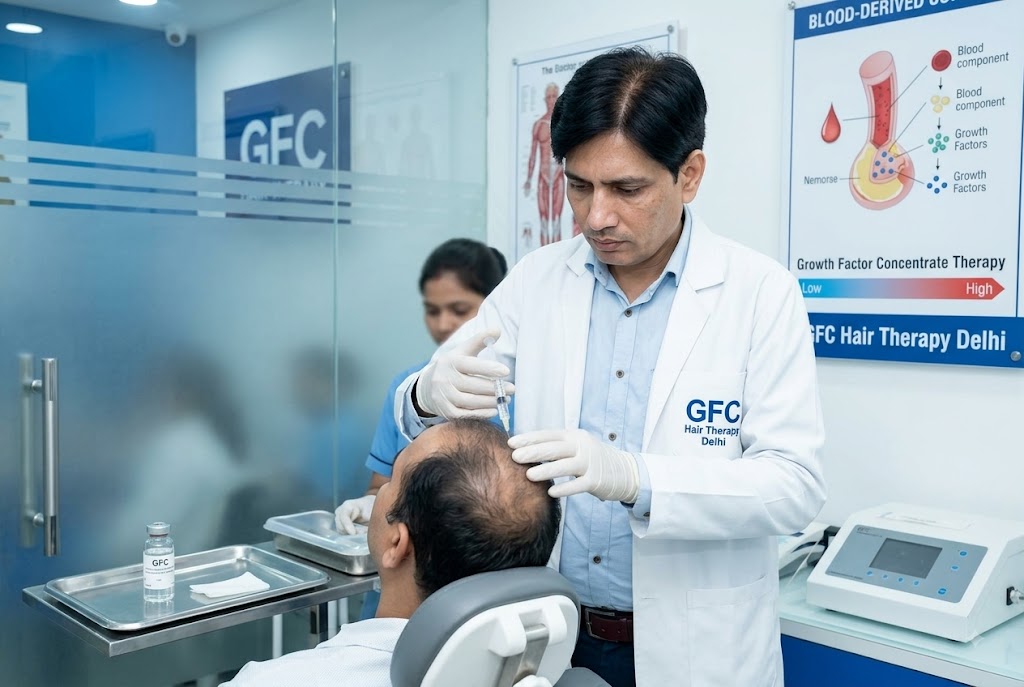
Hair thinning and progressive hair loss can affect both men and women. While several treatments are available for hair loss, GFC (Growth Factor Concentrate) therapy has become an option for people looking for a minimally invasive treatment that uses growth-factor-rich components derived from their own blood.
At Dr. Izharul Hasan – PRP Treatment Center, Delhi, GFC Hair Treatment is offered as part of a personalized approach to hair and scalp concerns. The appropriate treatment depends on the underlying cause, pattern and stage of hair loss, scalp condition, and the individual’s overall clinical assessment.
This guide explains what GFC hair treatment is, how the procedure is performed, its potential benefits, expected results, and what patients should know before considering treatment.
What Is GFC Hair Treatment?
GFC Hair Treatment stands for Growth Factor Concentrate Hair Treatment. It is an autologous regenerative approach in which a patient’s own blood is processed to obtain a concentrated preparation containing growth factors.
Growth factors are naturally occurring signaling proteins involved in processes such as tissue repair and cellular communication. In hair treatment, the aim is to deliver these biological signals to the scalp around areas of thinning hair.
Unlike a conventional hair transplant, GFC does not involve surgically moving hair follicles from one area of the scalp to another. It is an injection-based procedure performed on the scalp.
How Does GFC Treatment Work for Hair Loss?
Hair growth is influenced by several factors, including genetics, hormones, nutrition, inflammation, scalp health and the condition of individual hair follicles.
During GFC treatment, the prepared growth-factor concentrate is administered into selected areas of the scalp. The objective is to create a supportive environment around weakened or miniaturizing hair follicles.
GFC may be considered particularly when the follicles are still present but producing progressively thinner or weaker hair. However, it should not be presented as a guaranteed method of regrowing hair in every type or stage of hair loss.
A proper assessment is therefore important before starting treatment.
Who May Consider GFC Hair Treatment?
GFC may be considered for selected patients with conditions such as:
- Early or moderate pattern hair thinning
- Androgenetic alopecia
- Reduced hair density
- Progressive thinning of scalp hair
- Certain cases of diffuse hair loss after evaluation
- Patients looking for a non-surgical regenerative treatment option
The cause of hair loss should ideally be identified before treatment. Hair loss caused by nutritional deficiencies, thyroid abnormalities, certain medications, scalp disorders or other medical conditions may require treatment of the underlying problem.
GFC Hair Treatment Procedure
A typical GFC hair treatment session involves several steps.
1. Hair and Scalp Assessment
The first step is a clinical assessment of the scalp and pattern of hair loss. The doctor may evaluate:
- Hair density
- Hair shaft thickness
- Pattern of thinning
- Scalp condition
- Duration and progression of hair loss
- Relevant medical or lifestyle factors
Additional investigations may be recommended when clinically appropriate.
2. Blood Collection
A small amount of the patient’s own blood is collected under appropriate sterile conditions.
3. Preparation of GFC
The blood sample is processed using a specialized preparation technique to obtain a growth-factor-rich concentrate.
The exact processing system and concentration can vary depending on the equipment and protocol used by the treatment centre.
4. Scalp Application
The prepared GFC is administered through multiple small injections into selected areas of the scalp.
The treatment is performed with attention to sterile technique and patient comfort.
5. Post-Treatment Advice
Patients can generally return to their normal routine relatively quickly, although specific aftercare instructions should be followed according to the procedure performed.
What Are the Potential Benefits of GFC Hair Treatment?
GFC may offer several potential advantages for appropriately selected patients.
Uses the Patient’s Own Biological Material
Because GFC is prepared from the patient’s own blood, it is an autologous treatment.
Minimally Invasive
GFC is delivered through scalp injections rather than through a surgical hair-restoration procedure.
May Support Weakened Hair Follicles
Growth factors are involved in cellular signaling and tissue repair. GFC treatment aims to provide these signals around areas of hair thinning.
Can Be Used as Part of a Personalized Hair Plan
GFC does not necessarily have to be considered as an isolated treatment. Depending on the diagnosis, it may form part of a broader hair-loss management plan.
GFC vs PRP for Hair Loss
GFC and PRP are both autologous injectable treatments, but they are not identical. GFC and PRP are different autologous injectable treatments. If you want to understand how PRP is used for hair restoration, you can also read our detailed guide on PRP Hair Treatment in Delhi
PRP (Platelet-Rich Plasma) involves concentrating platelets and plasma from the patient’s blood. PRP contains various growth factors and other biological components.
GFC (Growth Factor Concentrate) focuses on preparing a growth-factor-rich concentrate using a specific processing method.
The terminology and preparation protocols can vary between systems and clinics, so patients should ask which GFC technology and protocol are being used.
There is also no universal rule that GFC is automatically “better” than PRP for every patient. Treatment selection should depend on the individual’s diagnosis, hair-loss stage, treatment goals and clinical assessment.
How Many GFC Sessions Are Needed?
The number of GFC sessions is not the same for every patient.
A treatment plan may depend on:
- The severity of hair thinning
- The underlying cause of hair loss
- Age and general health
- Existing hair density
- Scalp condition
- Previous treatments
- Individual response to therapy
Some patients may require a series of sessions followed by maintenance treatment, while others may have a different treatment schedule.
Rather than choosing a fixed number of sessions solely from an online article, it is better to determine the treatment plan after an individual consultation.
When Can You Expect GFC Hair Treatment Results?
Hair growth is a gradual biological process, so results should not be expected immediately after treatment.
Patients may notice changes in hair shedding, hair texture or density at different stages, but the timeline varies considerably between individuals.
Visible improvement, when it occurs, generally requires patience and assessment over several months rather than a few days or weeks.
Results can be influenced by:
- The cause and stage of hair loss
- The condition of the follicles
- Age
- Hormonal factors
- Nutrition
- Scalp health
- Treatment adherence
- Individual biological response
For this reason, before-and-after photographs and clinical assessment over time can be more useful than expecting a fixed result by a specific date.
GFC Hair Treatment Aftercare
After a GFC session, patients should follow the specific instructions provided by their treating doctor.
General recommendations may include:
- Avoid unnecessarily touching or scratching the treated scalp immediately after treatment.
- Follow the recommended hair-washing instructions.
- Avoid applying irritating scalp products unless advised.
- Follow any medication or topical treatment instructions provided.
- Inform the doctor if unusual or persistent symptoms develop.
Mild tenderness, redness or temporary discomfort can occur following scalp injections. The treating clinician should explain the expected post-treatment effects and when to seek further assessment.
Is GFC Hair Treatment Safe?
GFC uses the patient’s own blood-derived material, but that does not mean complications are impossible.
As with other injection-based procedures, temporary pain, redness, swelling or tenderness may occur. Infection and other complications are uncommon when appropriate sterile procedures are followed, but they remain possible.
Patients should disclose relevant medical history, medications and scalp conditions before treatment.
The treatment should be performed by an appropriately qualified healthcare professional using suitable sterile protocols.
GFC Hair Treatment in Delhi at PRP Treatment Center
If you are searching for GFC Hair Treatment in Delhi, an important first step is to determine whether GFC is appropriate for your particular type of hair loss.
At Dr. Izharul Hasan – PRP Treatment Center, Delhi, hair-loss concerns can be assessed based on the pattern of thinning, scalp condition, history of hair loss and previous treatments.
The aim is not simply to recommend an injection-based treatment, but to understand the patient’s hair-loss concern and develop an appropriate treatment approach.
Patients from Karol Bagh and other parts of New Delhi can consult for evaluation of hair fall, thinning hair and other scalp-related concerns.
Frequently Asked Questions About GFC Hair Treatment
Is GFC Hair Treatment the same as PRP?
No. Both are autologous blood-derived treatments, but their preparation methods and biological composition are different. GFC focuses on a growth-factor-rich concentrate, while PRP is based on platelet-rich plasma.
Is GFC suitable for severe baldness?
GFC may be less useful when hair follicles are no longer viable. Its potential role depends on the type and stage of hair loss. Advanced hair loss may require consideration of other hair-restoration options.
How long does a GFC session take?
The duration can vary depending on the preparation system, scalp area being treated and clinic protocol. Your treating doctor can provide the expected session duration during consultation.
Does GFC permanently stop hair loss?
GFC should not be described as a permanent cure for every form of hair loss. Hair loss can have genetic, hormonal, nutritional, inflammatory and other causes, and ongoing management may be required.
Can women undergo GFC Hair Treatment?
Yes, GFC may be considered for appropriately selected women with hair thinning. However, the underlying cause of female hair loss should be evaluated before starting treatment.
When should I consider GFC for hair loss?
If you are experiencing progressive thinning, increased hair shedding or reduced hair density, an early assessment can help determine the cause and available treatment options.
Is GFC better than PRP?
Not necessarily. GFC and PRP are different treatment approaches, and neither should automatically be considered superior for every patient. The appropriate option depends on individual clinical circumstances.
Can GFC be combined with other hair treatments?
Depending on the patient’s diagnosis and treatment plan, GFC may be combined with other hair-loss management approaches. Combination treatment should be planned by the treating clinician rather than based solely on online information.
Final Takeaway
GFC Hair Treatment in Delhi is a minimally invasive, autologous treatment option designed to deliver a growth-factor-rich preparation to areas of scalp hair thinning.
It may be considered for selected patients, particularly when hair follicles are still present but producing progressively weaker or thinner hair. However, treatment response varies, and GFC is not a guaranteed solution for every type of hair loss.
The most appropriate approach is to first identify the likely cause and stage of hair loss and then discuss whether GFC, PRP, medication, lifestyle correction, or another treatment option is appropriate.
For hair-loss evaluation and GFC treatment consultation in Delhi, patients can consult Dr. Izharul Hasan at PRP Treatment Center, Karol Bagh, New Delhi.
Medical Note
This article is intended for general educational purposes and does not replace an individual medical consultation. Hair-loss treatment should be selected after appropriate clinical assessment. Re

